

The Studio Owner’s Guide to Commercial Stationary Bikes: Design, Durability, and ROI
By Chris Rossi, Fitness Facility Design Specialist at Opti-Fit | Central Coast
If you are opening a spin studio in San Luis Obispo or upgrading a boutique fitness facility in Santa Barbara, you know that the stationary bike is more than just equipment—it is the engine of your business.
While generic reviews might steer you toward high-end home units like the NordicTrack S22i or Peloton, a commercial environment demands something entirely different. When a bike needs to withstand 4 to 6 classes a day, seven days a week, “heavy-duty” takes on a new meaning.
At Opti-Fit, we don’t just sell equipment; we design fitness experiences. From the Central Coast of California to the high-rises of Nevada, we help studio owners select fleets that balance performance, aesthetics, and Return on Investment (ROI).
This guide goes beyond the specs to explore what truly matters when choosing commercial stationary bikes for fitness studios.
Why “Commercial Stationary Bikes Grade” Is Non-Negotiable for Studios
The top search results often confuse “light commercial” (garage gyms, hotels) with “full commercial” (dedicated studios). For a fitness studio, the difference is catastrophic failure vs. reliable revenue.
1. Usage Volume
A high-traffic studio bike on the Central Coast might see 1,500+ hours of use per year. Home bikes are engineered for maybe 300. Commercial bikes feature oversized crank arms, rust-resistant powder coating (sweat is corrosive), and sealed bearings to handle the load.
2. The Q-Factor
This is the distance between the pedal attachment points. Commercial indoor cycles aim for a narrower Q-factor (155mm–170mm) to mimic the ergonomics of a real road bike. This reduces knee strain for your riders—a critical factor for member retention.
3. Drive Systems: Belt vs. Chain
- Chain Drive: The old-school “rumble.” It feels authentic but requires frequent lubrication and is noisy.
- Belt Drive (Poly-V or Carbon Blue): The studio standard. It is silent, smooth, and virtually maintenance-free. For a boutique studio where the instructor’s playlist is god, a silent belt drive is mandatory.
Top Considerations for Your Studio Fleet
When I consult with clients in Monterey or Paso Robles, we evaluate bikes based on three pillars: Adjustability, Connectivity, and Serviceability.
1. Micro-Adjustability is King
Your riders come in all shapes and sizes. You need bikes with four-way adjustability (seat height/fore-aft and handlebar height/fore-aft).
- Pop-pin vs. Lever: Levers are faster and tighter than pop-pins.
- Fit Range: Ensure the bike accommodates riders from 4’11” to 6’8”.
2. Console Technology: Open vs. Closed Ecosystems
This is where many studio owners get trapped.
- Closed Ecosystems (e.g., Peloton Commercial): You are locked into their content and subscription model.
- Open Platforms (e.g., Stages, Schwinn, Matrix): These allow you to use your own software (Spivi, Zwift, or proprietary studio apps). This flexibility is crucial for branding your studio, not someone else’s.
3. Power Meters and Metrics
Does your studio focus on “Rhythm” (dancing on the bike) or “Power” (watts and RPM)?
- Rhythm Studios: You need simple consoles or no consoles. Focus on the flywheel weight and smoothness.
- Performance Studios: You need strain-gauge power meters with +/- 1% accuracy to run leaderboards.
Top Commercial Stationary Bike Recommendations for 2026
Based on our installations and maintenance data, these are the top performers that outlast the competition.
1. The Workhorse: Stages SC3
- Best For: Performance and Metric-driven studios.
- Why: The SprintShift lever allows for instant resistance jumps, and the power meter is self-powered (no batteries to change constantly). It is a staple in top-tier studios globally.
2. The Smooth Operator: Schwinn AC Power
- Best For: Rhythm and General Fitness.
- Why: It uses a Carbon Blue belt drive that feels incredibly realistic (like a chain) but without the noise. The “morphed” handlebars offer the most comfortable hand positions in the industry.
3. The Tech Leader: Matrix CXP Target Training Cycle
- Best For: Gamified experiences.
- Why: The unique “Target Training” LED wrap on the console uses color to guide riders, making it easy for instructors to coach intensity without screaming numbers.
(Note: While review sites push Echelon or NordicTrack, we recommend speaking to a commercial distributor about warranty support before putting these in a paid-class environment.)
Beyond the Bike: Design and Layout
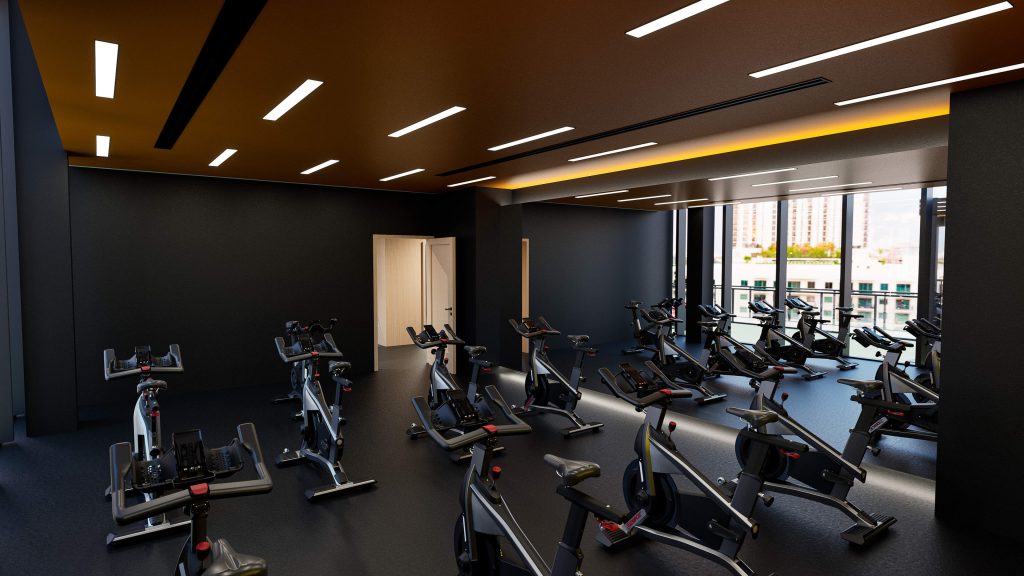
Buying the bikes is step one. Fitting them into a space that flows is where Opti-Fit excels. A crowded room kills the vibe; a sparse room kills the energy.
The “Stadium” Layout
On the Central Coast, where real estate is premium, we often utilize tiered decking.
- Spacing: We recommend a minimum of 24 inches between handlebars to allow for “movement” choreography (push-ups, tap-backs).
- Sightlines: Every rider needs to see the instructor. We use 3D rendering to ensure no pillar or bad angle ruins a paying member’s experience.
Acoustics and Flooring
Vibration control is essential. We specify high-density rubber flooring that absorbs the “thrum” of 30 flywheels spinning at once, keeping your sound crisp and your neighbors happy.
ROI and Maintenance: The Silent Profit Killer
A bike with an “Out of Order” sign is a commercial stationary bike that isn’t generating revenue.
- Preventative Maintenance: We suggest a quarterly service contract. Tightening crank arms and checking pedal threads can double the life of your fleet.
- Warranty Management: When you buy from a big-box retailer, you are the warranty department. When you partner with Opti-Fit, we handle the logistics, parts, and technicians.
Frequently Asked Questions
Q: What is the best commercial stationary bike for a spin studio? A: For durability and metrics, the Stages SC3 is the industry leader. For an authentic road feel, the Schwinn AC Power is top-tier. Avoid residential “smart bikes” for heavy commercial use.
Q: How much space do I need per bike in a spin studio? A: You should allocate approximately 20-25 square feet per bike to account for the bike’s footprint, safe mounting/dismounting, and walkways.
Q: Can I use residential bikes like Peloton in my commercial studio? A: Generally, no. Residential warranties are voided in commercial settings, and the components are not designed for consecutive hours of daily use.
Partner with Opti-Fit
Whether you are building a new luxury wellness center in Paso Robles or revamping a corporate gym in San Luis Obispo, your equipment choices define your brand. Don’t leave your success to a generic “Add to Cart” button.
I have spent decades helping facility owners navigate these decisions. Let’s discuss your vision, your budget, and how we can bring the energy of the Central Coast to your fitness space.
Ready to design your world-class studio?
> Schedule a Meeting with Chris Rossi
Opti-Fit Fitness Solutions Planning. Design. Execution. Serving California, Nevada, and the Pacific Northwest. coverage.
Website: Opti-Fit.com